What Is a Gas Turbine Engine?
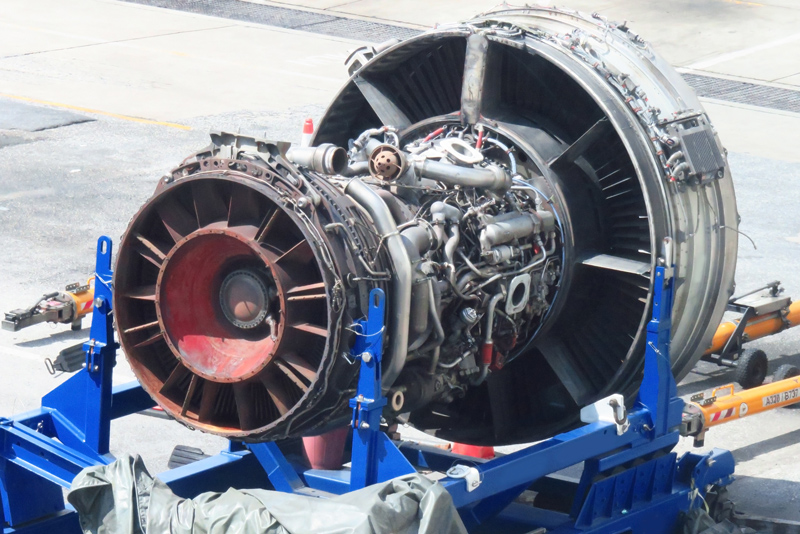
Gas turbine engines are among the most important propulsion technologies in modern aviation. These engines power a wide range of aircraft, from high-speed commercial jetliners to military helicopters and heavy-lift cargo aircraft.
Gas turbine engines operate on a relatively simple principle: air is compressed, mixed with fuel, ignited, and expanded through turbine stages to produce thrust or rotational power. Despite this straightforward concept, turbine engines represent one of the most advanced engineering achievements in aerospace technology.
Today, gas turbine engines power thousands of aircraft operating worldwide and remain the dominant propulsion system in both military and commercial aviation.
How Gas Turbine Engines Work
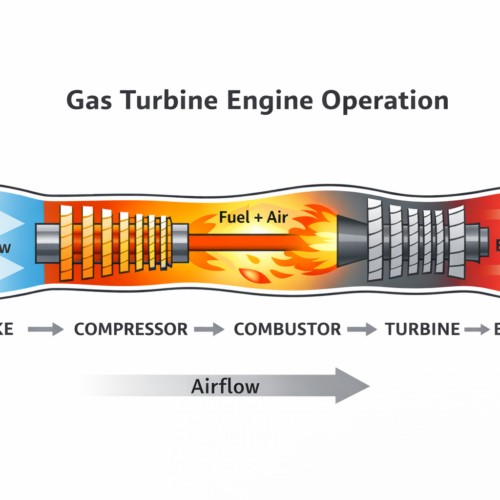
At a basic level, all gas turbine engines operate using the Brayton thermodynamic cycle, which consists of four primary stages.
1. Air Intake
Air enters the front of the engine through the intake section and flows toward the compressor.
2. Compression
The compressor increases the pressure of the incoming air through multiple stages of rotating and stationary blades. This compressed air becomes significantly hotter and denser.
3. Combustion
Fuel is injected into the compressed air inside the combustion chamber and ignited. This process produces a high-energy stream of expanding gases.
4. Expansion Through the Turbine
The hot gases pass through turbine stages that extract energy to drive the compressor and other engine systems.
Depending on the engine design, the remaining energy is used to generate either jet thrust or rotational shaft power.
Diagram: Basic Gas Turbine Engine Operation
Types of Gas Turbine Engines
Several types of gas turbine engines are used in aviation today. Each configuration is designed for specific aircraft applications and performance requirements.
Turbojet Engines
The turbojet is the earliest type of gas turbine engine used in aviation. Turbojets produce thrust by accelerating exhaust gases out of the engine nozzle at extremely high speeds.
While turbojets were widely used in early jet aircraft, they are less fuel efficient than modern designs and are now rarely used in commercial aviation.
Turbofan Engines
Most commercial airliners today use turbofan engines.
A turbofan engine includes a large fan at the front that moves a significant volume of air around the core turbine engine. This improves efficiency and reduces noise.
Common turbofan-powered aircraft include:
- Boeing 737
- Airbus A320
- Boeing 787
Turbofans are the dominant propulsion system in modern passenger aviation.
Turboprop Engines
A turboprop engine uses a gas turbine to drive a propeller rather than producing thrust directly from exhaust gases.
Turboprops are typically used on regional aircraft and utility airplanes because they are highly efficient at lower speeds and shorter flight distances.
Common turboprop aircraft include:
- ATR regional aircraft
- De Havilland Dash 8
- various military transport and patrol aircraft
Turboshaft Engines
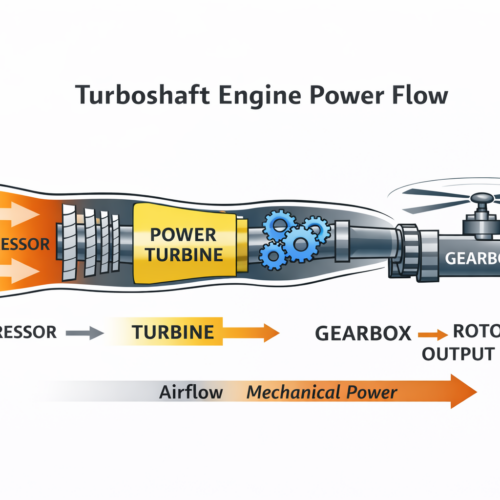
A turboshaft engine is specifically designed to produce rotational shaft power rather than jet thrust. This configuration makes turboshaft engines ideal for helicopters and other applications requiring mechanical power output.
In a turboshaft engine, turbine energy drives a power shaft connected to a gearbox, which then drives the helicopter rotor system.
Examples of turboshaft engines include:
- T53 Turboshaft Engine used in the Bell UH-1 Huey
- T55 Turboshaft Engine powering the Boeing CH-47 Chinook
- T700 Engine used in the Sikorsky UH-60 Black Hawk
Diagram: Turboshaft Engine Power Flow
Advantages of Gas Turbine Engines
Gas turbine engines offer several advantages over piston engines, which led to their widespread adoption in aviation.
Key advantages include:
- High power-to-weight ratio
- Greater reliability and fewer moving parts
- Smooth and consistent power output
- Ability to operate efficiently at high altitude
- High power output for heavy-lift aircraft and helicopters
These advantages are particularly important in helicopter operations where engine reliability and performance are critical.
Continued Importance in Aviation
Gas turbine engines remain the backbone of modern aviation propulsion. Advances in materials, aerodynamics, and digital engine controls continue to improve turbine efficiency and reliability.
Even legacy turbine engines developed decades ago, such as the T53 and T55 turboshaft engines, continue to operate in aircraft fleets around the world. Their durability and upgrade potential allow operators to maintain reliable aircraft capability for many years.
Supporting Turbine Engine Platforms
Supporting gas turbine engines requires specialized expertise and access to a global supply chain of parts, components, and repair capabilities.
Established in 1972, Transupport provides sourcing and distribution services for turbine engine systems and components used across a wide range of aviation platforms.
The company supports turbine-powered systems including:
- T53 Turboshaft Engines
- T55 Turboshaft Engines
- AGT1500 Gas Turbine Systems
- Fuel system components manufactured by TRIUMPH Systems, Electronics & Controls
Through its global network of aviation partners and suppliers, Transupport helps operators maintain reliable turbine engine operations worldwide.
Learn More
For additional information regarding turbine engine systems or parts availability, contact the Transupport team today.